
This Is Why ICP Is Being Supressed, And How Anthropic Proved It Yesterday

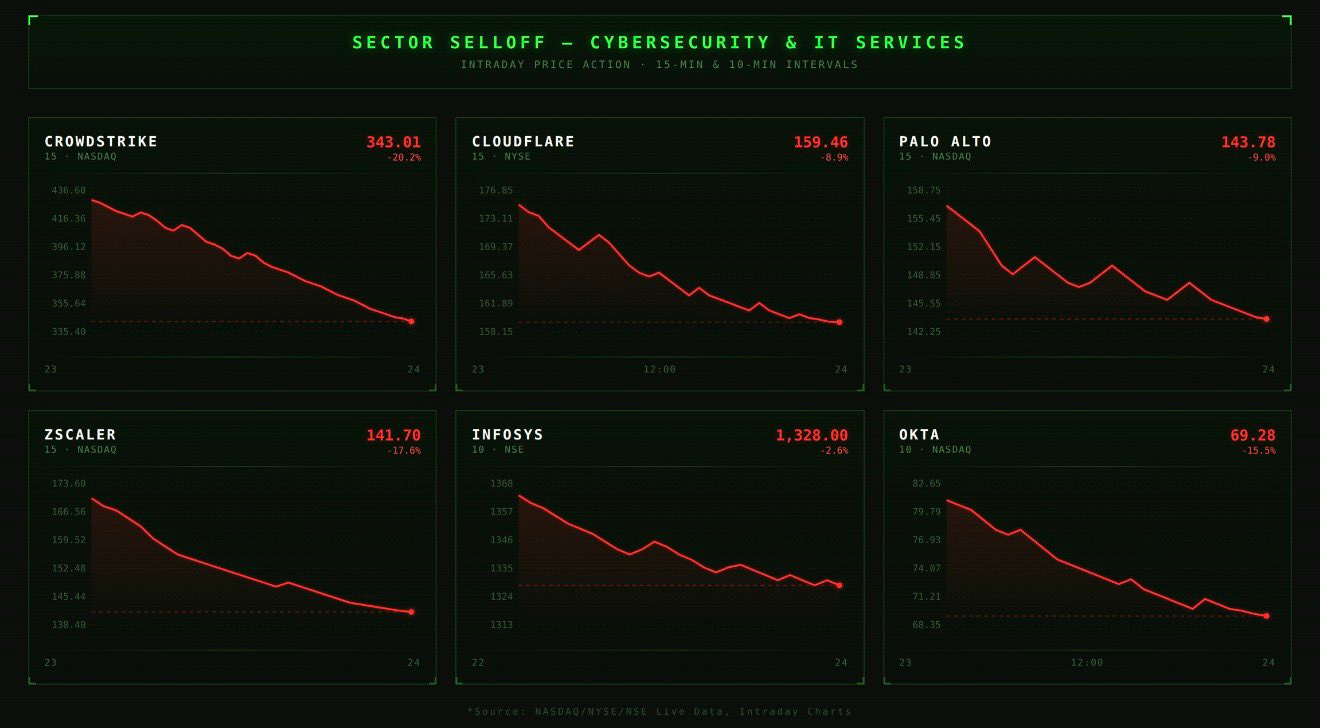
A single product announcement from Anthropic wiped billions off the valuations of some of the most established names in cybersecurity. Companies such as CrowdStrike, Okta, and Cloudflare lost nearly 10% of their market cap in a matter of days. The “Global X Cybersecurity ETF” hit its lowest point since November 2023. All of this because an AI tool capable of scanning codebases for vulnerabilities threatened to automate away a big chunk of what these companies sell.
Now let me ask you something: if that is the market’s reaction to an AI tool that patches holes in existing infrastructure, what would the reaction be to a technology that makes those holes structurally impossible in the first place?
The technology I’m talking about is of course the Internet Computer Protocol, and the fact that this question is not being asked across the crypto market right now tells you everything about where we are in the ICP adoption cycle.
Current Internet Issues
To understand why ICP’s security model is genuinely different, you need to understand what the traditional approach to cybersecurity actually is.
The entire cybersecurity industry, the one whose stocks just cratered, exists because of a fundamental design flaw baked into how the internet was built. Applications run on centralized servers, and those servers are owned by companies. Those companies have administrators, and those administrators have credentials which can be stolen, compromised, or abused.
Every layer of protection that CrowdStrike, Okta, Zscaler, and the rest of the industry sells is essentially a patch on top of this flawed foundation. Endpoint detection and response tools watch for attackers who have already gotten in. Identity management platforms try to make sure the person logging in is actually who they claim to be. Firewall and network security products attempt to keep the wrong people out of places they shouldn’t be.
These are all necessary products because the underlying architecture invites attack. Essentially, it’s like putting a better lock on a door that was designed to be opened.
The result is an arms race with no end. Forescout’s 2025 Threat Roundup, which analyzed over 900 million attacks recorded worldwide last year, found that cyberattacks became more globally distributed and cloud-enabled throughout 2025, with activity traced across 214 countries and territories. More than 30,000 vulnerabilities were disclosed in 2025 alone, a 17% increase from the year before. The cost of recovering from a ransomware attack now averages $2.73 million. The industry keeps growing because the problem keeps growing, not because it is being solved.
ICP is not trying to win this arms race, instead it’s trying to end it by completely changing the architecture.
What “Tamper-Proof” Actually Means
This word gets thrown around a lot in crypto, so let me be precise about what it means in ICP’s context, because it goes further than most people realize.
Applications on the Internet Computer run inside smart contracts called canisters. These canisters execute on a network of independent node machines distributed across the globe. No single company owns these nodes, and no administrator has privileged access to your canister. There is no central server to compromise, database to breach, or backdoor to exploit.
Every state change in the network goes through Byzantine Fault Tolerant consensus, which means every modification has to be cryptographically validated across thousands of independent machines simultaneously. To tamper with an application running on ICP, you would need to corrupt a supermajority of independent node providers across multiple jurisdictions at exactly the same moment. In practical terms, that is virtually impossible.
The DFINITY Foundation’s official positioning is direct: apps hosted on the Internet Computer are tamper-proof and immune to traditional cyber attacks. The United Nations is already using ICP to create tamper-proof, verifiable credentials. DFINITY has partnered a while ago with FEDERITALY to bring supply chain transparency to Italian goods on-chain. Pakistan’s Digital Authority signed an MOU with DFINITY earlier this month to build a sovereign AI cloud infrastructure using ICP.
These are governments and international organizations making infrastructure bets on the premise that ICP’s security model holds up under real-world conditions.
These Sectors Would Feel It
Here is where the thought experiment gets interesting, and where I think the ICP community has not been loud enough in articulating the case.
The cybersecurity industry is worth roughly $200 to $300 billion annually and growing rapidly. But cybersecurity is not the only industry whose business model rests on the insecurity of centralized infrastructure.
Identity and Access Management is a massive category. Okta alone is worth tens of billions. The entire premise is that you need a trusted intermediary to verify who someone is and what they are allowed to access. ICP has Internet Identity, a blockchain authentication system that creates cryptographic aliases for users across services. It doesn’t use passwords, or central databases of credentials, and there is no single company sitting in the middle of every login that becomes a target. If ICP becomes the authentication layer for internet applications, the identity and access management market gets structurally disrupted at the foundation.
Cloud Infrastructure is another one. Z-Scaler’s business is built on securing the connection between users and cloud applications. Cloudflare makes its money protecting web infrastructure from attack. Both of these markets exist because applications run on vulnerable centralized servers that need protection from the open internet. If your application runs natively on a decentralized, tamper-proof network, the threat model that justifies these businesses changes dramatically.
Enterprise Software more broadly faces a different kind of pressure. When ICP’s Caffeine and other tools on the network start generating fully functional on-chain applications from natural language descriptions, the purpose of every traditional Software as a Service vendor starts looking thinner. This is the same “vibe coding” fear that has been hitting software stocks across the board, but with an additional layer: the apps being generated live on infrastructure that doesn’t need a separate security stack layered on top.
The point is not that ICP will immediately destroy these industries. The point is that mainstream ICP adoption would force a fundamental risk across all of them simultaneously. And this is precisely something that this companies don’t want to happen. Their business is patching vulnerabilities, so they need those vulnerabilities to exist in order to remain relevant and rake in billions a year. They have no interest in fixing the underlying issues.
The Crypto Market Acts Like ICP Doesn’t Exist
The ICP community has been asking for years why the project gets ignored relative to its technical achievement, and I think the honest answer has a few parts.
Firstof all, the narrative is hard to sell quickly. “We are replacing the foundational architecture of the internet” is not a 30-second pitch. DeFi yields, meme coins, and NFT collections are easier to understand and faster to speculate on. ICP is building something that takes years to appreciate and even longer to reach the mainstream adoption that unlocks its full value proposition. That is genuinely difficult for a market that prices momentum.
Second, the token launched at the top of the 2021 bull market at an all-time high above $700 and has spent years recovering from that overhang. That history creates a psychological barrier that has nothing to do with the technology and everything to do with the chart. Whether that launch was engineered by competitors or not is not the purpose of this article. We’re here to explore the current reality as it stands.
Third, the security narrative specifically requires a level of technical depth that most crypto commentary does not go to. It is much easier to write about transaction speeds and yield rates than to explain chain key cryptography and Byzantine Fault Tolerance in a way that makes the investor case clear. So the case often doesn’t get made at all, or it gets made in technical documentation that reaches developers but not capital allocators.
But here is what is changing. The Anthropic announcement did something useful. It forced a very public conversation about AI automating away the value of traditional cybersecurity products. Analysts were out within days arguing the selloff was an overreaction. Others wrote that the announcement actually strengthens the case for established vendors.
Maybe, but none of those analysts are asking the next question, which is “what happens when you remove the vulnerability at the infrastructure level rather than the application level?”, and that is the question ICP answers.
ICP Keeps Building
ICP is not waiting for the mainstream adoption narrative to catch up. The network is building non-stop.
Canister smart contracts on ICP grew from roughly 373,000 in January 2024 to nearly 980,000 by late 2025. That is a real measure of developer activity, not price speculation. ICP has led all cryptocurrency projects in GitHub commits for an extended period, with over 3,100 commits and more than 100 active contributors as recently as early 2026.
The vetKeys feature, now live in production, enables canisters to manage encrypted keys for users without users needing to remember passwords or manage decryption keys themselves. That alone is a meaningful primitive for building privacy-preserving applications that have no equivalent in traditional web infrastructure.
The Mission 70 proposal to reduce ICP’s annual inflation from 9.72% to 2.92% by the end of 2026, is moving forward. If network usage continues growing while supply growth compresses, the tokenomics case starts to look significantly different from where they sit today.
Conclusion
The Anthropic story is interesting not because it tells us something new about artificial intelligence, but because it reveals how sensitive markets are to the idea that foundational infrastructure can shift.
One AI vulnerability scanner scared investors out of billions in cybersecurity stock value in a single afternoon. The fear was simple: if artificial intelligence can automate what these companies sell, what are they actually worth?
ICP is not proposing to automate what the cybersecurity industry sells, but is proposing something more disruptive and, for the patient investor, more interesting. It is proposing to build internet infrastructure where the attack surface that the entire cybersecurity industry was built to protect no longer exists in the same form.
The market does not have a framework for pricing that yet. The crypto market is distracted by charts and cycles, and the traditional financial market does not speak the blockchain language yet. And so ICP continues to build, largely ignored, while the problems it was designed to solve grow more expensive and more visible with every passing quarter.
Historically, this is exactly where the best asymmetric opportunities tend to live.
If you made it this far, thank you for reading. And if you want more ICP articles like this one delivered straight to your inbox, consider subscribing to my Substack.
Talk to you later. BasedGiant.